Social accessories
Objects have social skills. Most of them go unused.
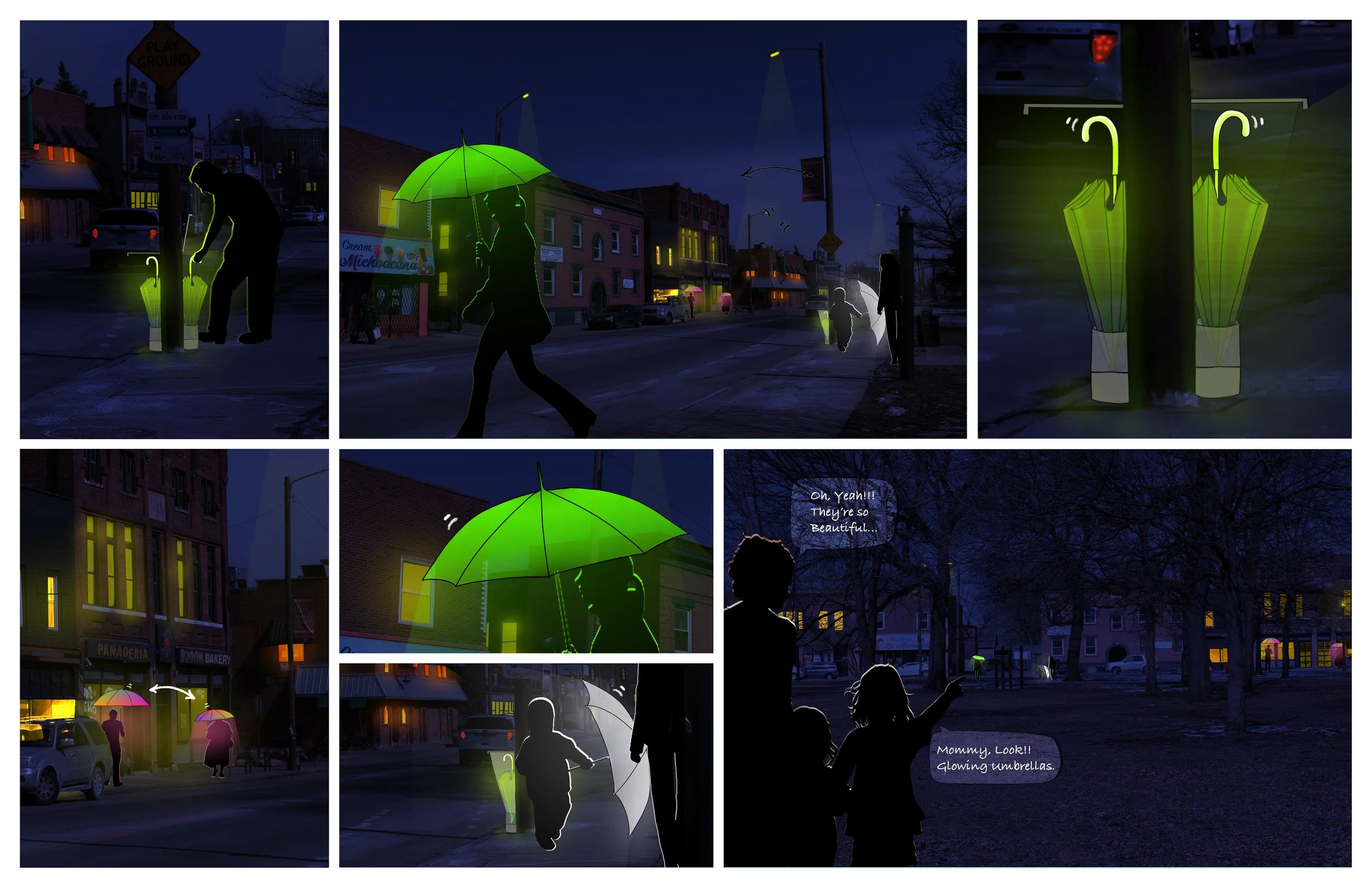
The values social accessories can embody: civility, transient collaboration, presence.
The sense of being in a shared situation with others. Openness to what the current moment contains.
These are not product features.
They are behavioral affordances: possibilities designed in, available to be discovered.
Social accessories matter in a specific way right now. As AI systems mediate more of our interaction with the world, as attention migrates from shared physical space to individual screens, the social texture of everyday public life is thinning.
We are increasingly in the same spaces without being in them together.
A social accessory is a design counter-proposal: a connected object that uses its capability not to further privatize attention but to create a moment of shared noticing. Brief, optional, appropriate — but genuinely social. A small demonstration that technology can bring people into relation rather than route them away from each other.
The question that produces a social accessory is not: how do we improve this object's core function?
It is: what social situation is this object already inside, and what one behavior could change what happens there?
The answer is almost always small. A blink. A sound. A light. A shared discovery that requires two people to unlock. The gesture is small. The effect, when it lands, is disproportionate — because genuine social encounter, however brief, is something technology rarely creates.
→ See in the work:
Curious Mirror ·
Ring My Bell ·
Small Talk Bus Stop ·
Free Range Umbrellas ·
Electro_Wink ·

Social accessories add a behavioral layer to an object — one that operates at the edge of its normal function, emerging from its physical presence and connected capabilities.
An umbrella is already a social object. You share one. You offer one to a stranger in rain. You shelter under someone else's. Something about its shape — wide, covering, inviting proximity — makes the social gesture natural.
Most designed objects do not work this way. They are designed for isolated use:
one person, one function, one transaction. Their social potential is incidental rather than intended.
Social accessories are a design category that begins from the opposite premise.
Every object exists inside a social situation. A bus stop is surrounded by strangers with nowhere to look. A parked car is at rest on a shared street. Headphones signal that a person is unavailable — but the person is still there, still in proximity to others, still in a situation that contains social possibility.
Social accessories add a behavioral layer to an object — one that operates at the edge of its normal function, emerging from its physical presence and connected capabilities. The layer is designed to invite a social encounter: a moment of
exchange between strangers, a shared gesture, an unexpected collaboration that neither person would have initiated alone.
The object takes the first step.
It creates an opening.
What happens in that opening belongs to the people who notice it.
Every object exists inside a social situation. A bus stop is surrounded by strangers with nowhere to look. A parked car is at rest on a shared street. Headphones signal that a person is unavailable — but the person is still there, still in proximity to others, still in a situation that contains social possibility.
Social accessories add a behavioral layer to an object — one that operates at the edge of its normal function, emerging from its physical presence and connected capabilities. The layer is designed to invite a social encounter: a moment of
exchange between strangers, a shared gesture, an unexpected collaboration that neither person would have initiated alone.
