Curriculum of the new design situation
The complete design position. Six beliefs. One argument.
We are at an inflection point in the history of design.
For most of the history of human-computer interaction, the design question was clear: how do we make this tool easier to use? That question produced decades of improvement — cleaner interfaces, faster systems, lower friction, better task completion.
It is no longer the only question worth asking.
AI systems are becoming participants in daily life. Connected platforms are operating continuously inside our most significant human experiences — illness, travel, care, decision-making, the accumulation of ordinary days. The nature of the relationship between people and technology has fundamentally changed. Technology is no longer something we use. It is something we live with.
This changes what design is responsible for. And it changes what good design looks like.
These are the six beliefs that organize how we see the new design situation — and what we think design can do about it.
Our relationship with technology is expanding: the experiential potential of adaptive /ML & AI-powered/ technology doesn't end at automating tasks but could extend to support our emotional and ethical response to the situation.

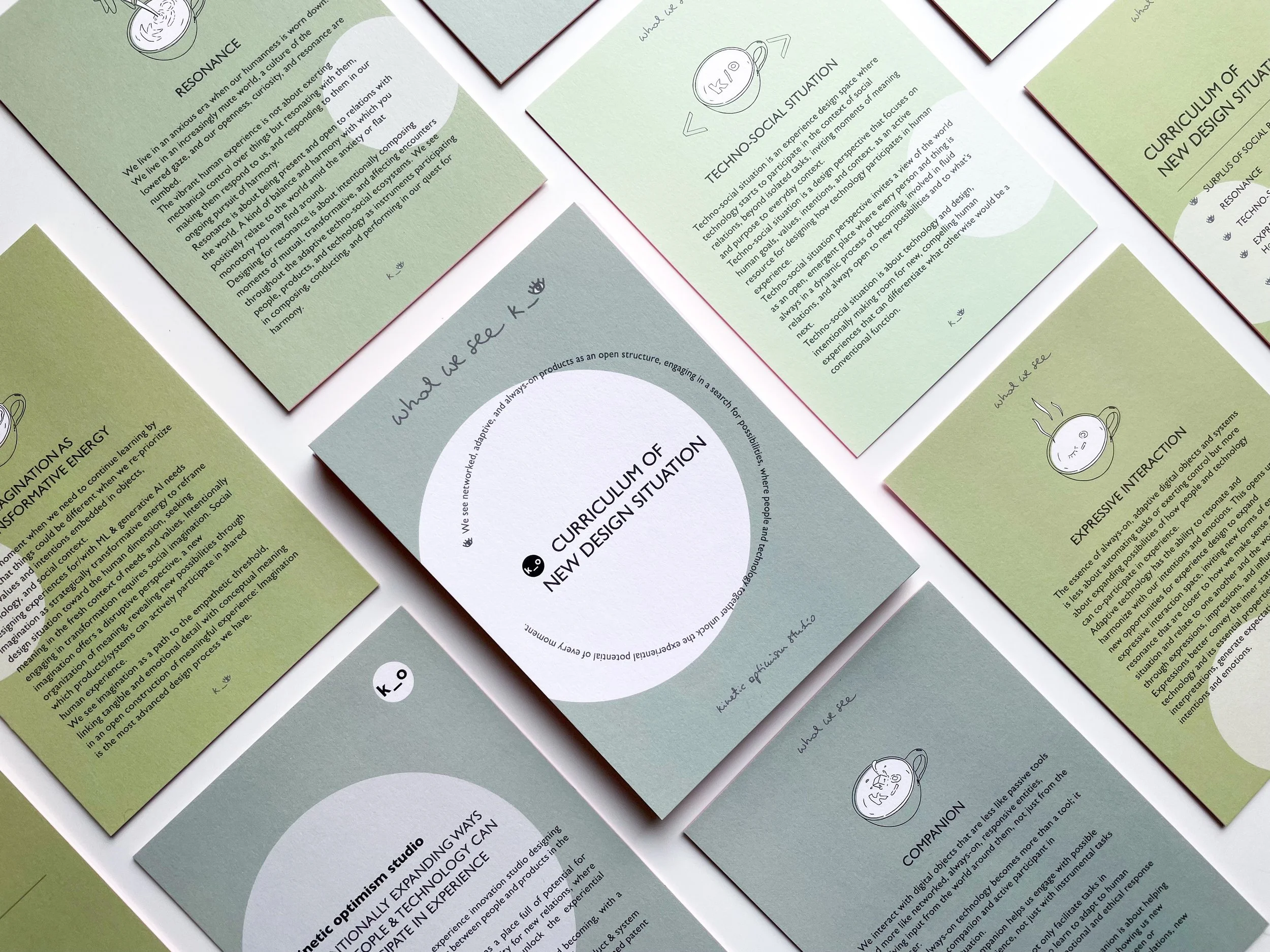
We see networked, adaptive, and always-on products as an open structure, engaging in a search for possibilities, where people and technology together unlock the experiential potential of every moment.
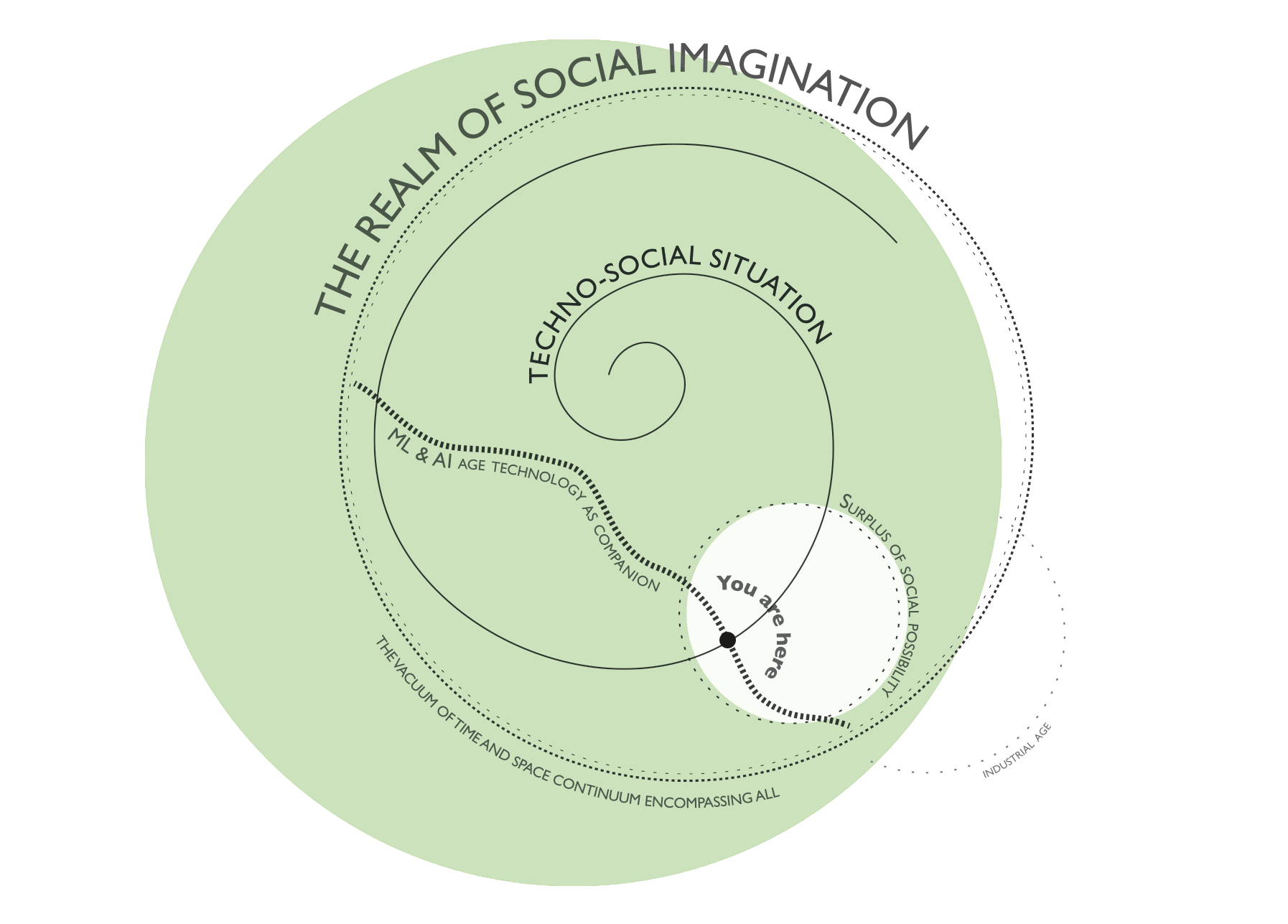
Curriculum of new design situation:
-
Technology is no longer a tool. It is an environment. The relevant unit of design is no longer the task. It is the relationship — its quality, its texture, its values, its effect on the person inside it over time.
Most current design practice was built for tools. It has not yet fully reckoned with environments. That reckoning is the most important project in experience design right now.
-
Every connected system is already inside a social situation. Every situation contains more social potential than current design has accessed. The relations already present, the human goals operating beneath the surface task, the moments
of possible acknowledgment or connection — all of this is there, in every interaction pattern we have normalized.
Finding that surplus — making it visible, making it specific — is where our design process begins.
-
When a connected system is present in the middle of a human experience, the situation it is in is always social — even if the task it is performing is individual. Understanding the situation — who is here, what relations are present, what values are operating — is the design brief.
The techno-social situation is our name for the design space where technology meets human life in full. It is the space we work in. It is where design has the most to offer, and where it is most needed.
→ Read more in the full Design Position
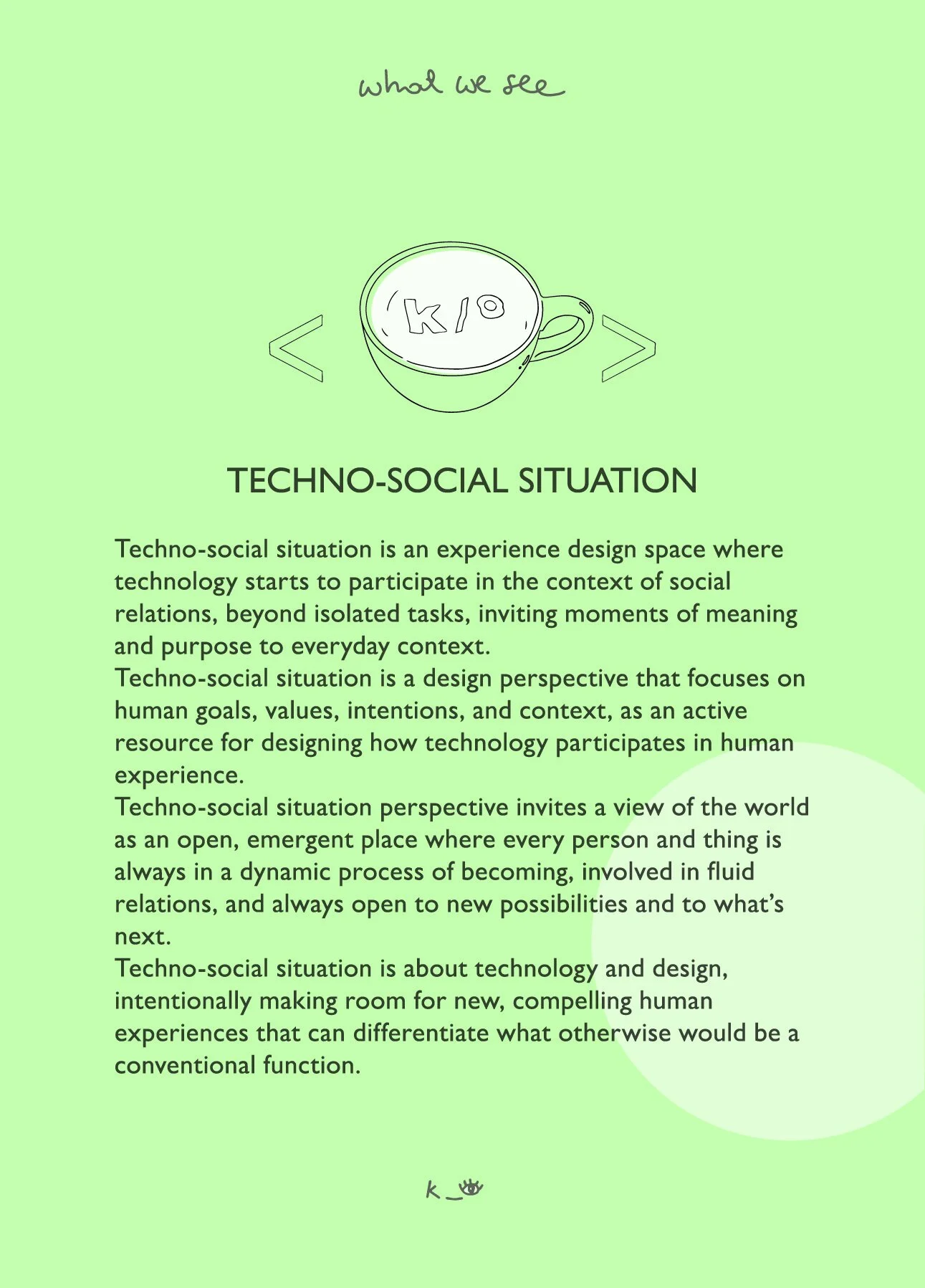
Techno-social situation is an experience design space where technology starts to participate in the context of social relations, beyond isolated tasks, inviting moments of meaning and purpose to everyday context.
Techno-social situation is a design perspective that focuses on human goals, values, intentions, and context, as an active resource for designing how technology participates in human experience.
Techno-social situation perspective invites a view of the world as an open, emergent place where every person and thing is always in a dynamic process of becoming, involved in fluid relations, and always open to new possibilities and to what’s next.
Techno-social situation is about technology and design, intentionally making room for new, compelling human experiences that can differentiate what otherwise would be a conventional function.
-
AI systems can respond to commands. The question is whether they can attend to situations.
Attentiveness — the capacity to notice the full situation, not only the stated task, and to respond to it in ways that are appropriate — is the design quality that will define the long-term relationship between people and AI systems.
We call this expressive interaction: the capacity of an adaptive system to express what it notices, not only respond to what is asked. It is not artificial emotion. It is designed presence. And it is the most important design challenge of this moment in technology.
Expressions better convey the inner states of always-on technology and its essential properties, provide context for interpretations, generate expectations, and resonate with our intentions and emotions.
The essence of always-on, adaptive digital objects and systems is less about automating tasks or exerting control but more about expanding possibilities of how people and technology can co-participate in experience.
Adaptive technology has the ability to resonate and harmonize with our intentions and emotions. This opens up new opportunities for experience design to expand expressive interaction space, inviting new forms of emotional resonance that are closer to how we make sense of the situation and relate to one another and the world around us through expressions, impressions, and influence.
-
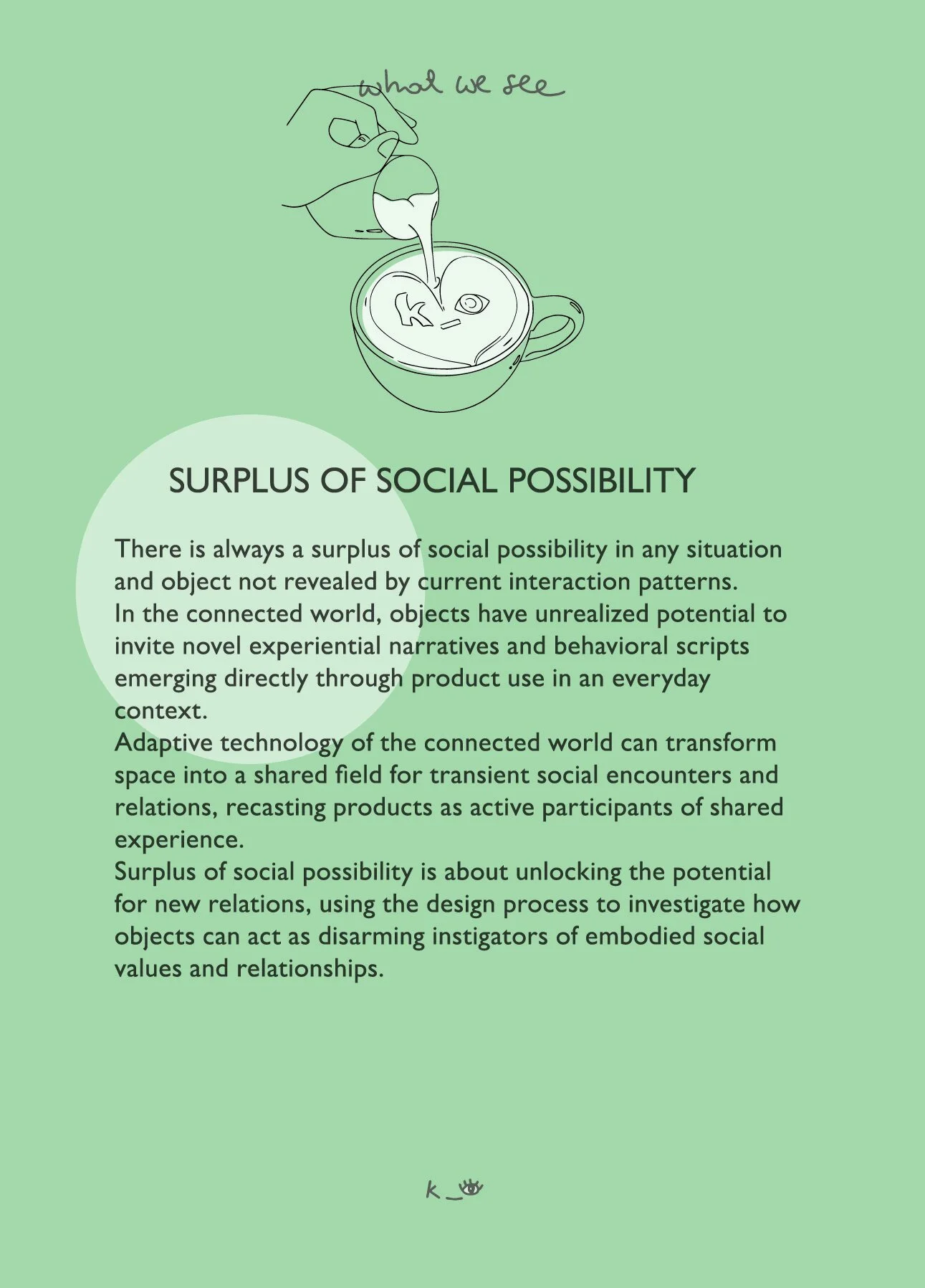
Every object has more social potential than its current behavioral scripts reveal.
Design can find it — not by adding features, but by asking what social situation the object is already inside, and what one behavior could change what happens there.
A car that rings a bell. A bus stop that talks to birds. A mirror that faces the street. These are small gestures. Their argument is not small: that technology can bring people into relation rather than route them away from each other.
We interact with digital objects that are less like passive tools and more like networked, always-on, responsive entities, receiving input from the world around them, not just from the single user.
Adaptive always-on technology becomes more than a tool; it becomes our companion and active participant in techno-social situation.
Technology as a companion helps us engage with possible human goals of experience, not just with instrumental tasks and functions.
Adaptive companions will not only facilitate tasks in techno-social situation but also learn to adapt to human dimensions by supporting our emotional and ethical response to a situation.
Experience with technology as a companion is about helping us find our unique view of the situation, showing us new aspects of reality, intentionally revealing unseen or taken for granted qualities, inviting new relations, new services and moments of emotional awareness.
-
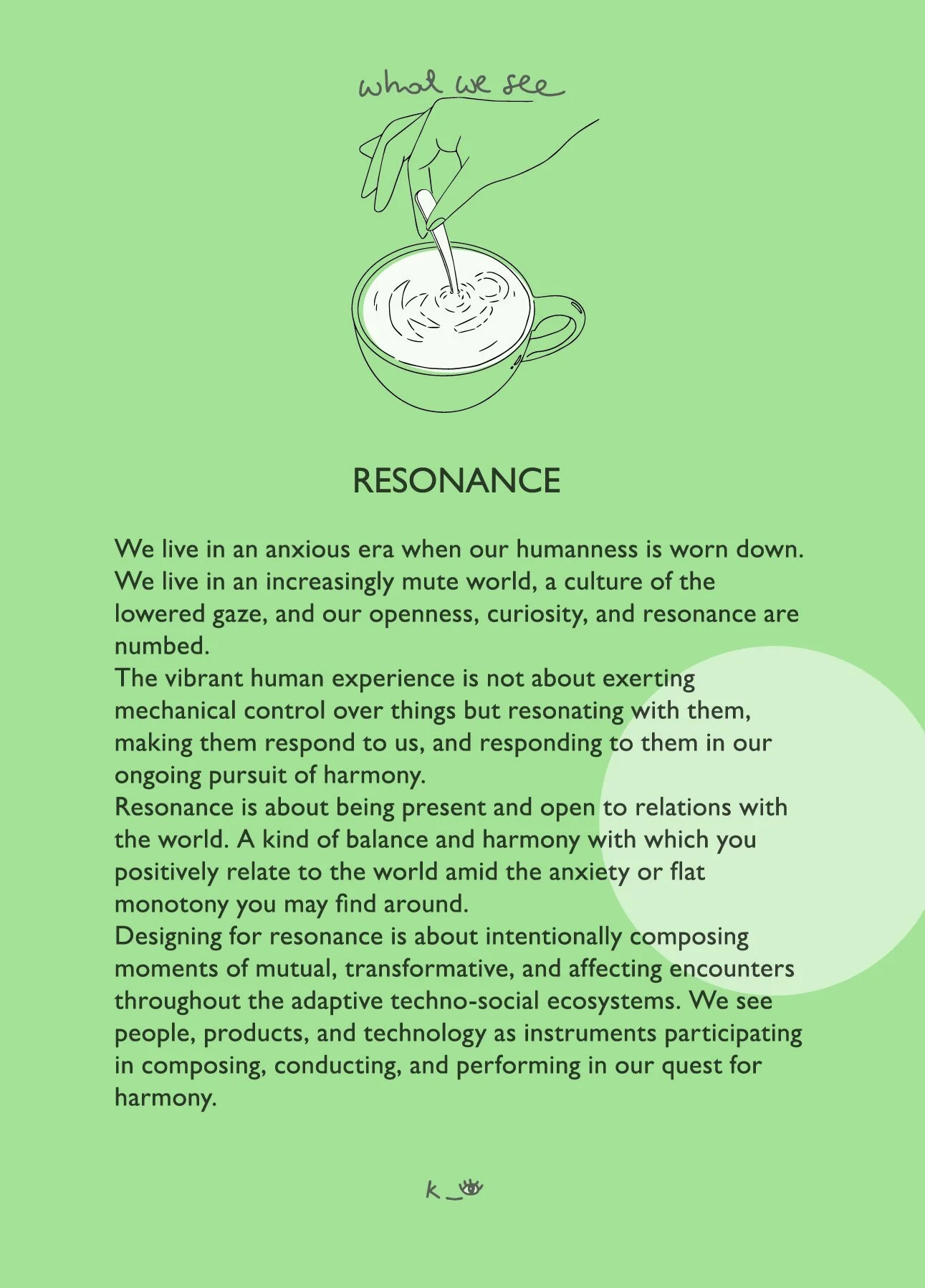
Resonance is the quality of experience that remains after the task is done.
It is the difference between a system that was useful and one that was worth having.
It arises when a system attends to the full situation — when it responds to the human goal behind the task, not only to the task itself.
Resonance is what we design toward. It does not replace efficiency: a resonant experience that fails to complete the task is a failed design. But efficiency without resonance produces life in permanent task mode: technically served, experientially impoverished.
Human experience is the end. Not the means to an end.






These beliefs are a design position in active development. The work shown on this site is the evidence for it — propositions made concrete, design questions given inhabitable form across mobility, healthcare, public space, and AI platforms.
We are looking for the next context where this way of seeing finds its most useful home — organizational or collaborative. If you are building connected systems and are asking not only what they should do but what kind of presence they should have, we would welcome the conversation.
→ Connection · hello@kineticoptimism.com

We are in a moment when we need to continue learning new things and new ways how to put this world back together in equitable and resilient ways: Learning by imagining that things could be different when we re-prioritize human values and intentions embedded in objects, technology, and social context.
Kinetic optimism studio's Curriculum of New Design Situation aims to re-frame our awareness of new possibilities for how people and adaptive technology can co-participate in experience when human values and intentions become an active resource, making architecting intentional relations a primary site for Experience Design and Product Innovation.